
Table of Contents
- Quick Comparison: 5 Charleston Retirement Communities With Golf
- How We Selected These Charleston Retirement Communities
- 1. Daniel Island: Best Overall 55+ Community With Golf Access
- 2. Wild Dunes Resort: Best Resort-Style Coastal Golf Living
- 3. Seabrook Island: Best Gated Golf Community Near Charleston
- Frequently Asked Questions
Last Updated: October 7, 2026
Quick Comparison: 5 Charleston Retirement Communities With Golf
Choosing among Charleston retirement communities comes down to one question most guides dodge: do you want an age-restricted neighborhood, a continuing care community, or a golf community that simply skews older? Those are three different things, and the Charleston area has all three. This guide from The Mills Team covers five communities where golf is part of daily life, and we’re upfront about which ones are truly 55+ and which are not.
Here’s the short answer up front:
| Community | Type | Golf Access | Best For |
|---|---|---|---|
| Daniel Island | Active-adult | Community golf amenity | Best overall |
| Wild Dunes Resort | Resort (all ages) | Resort courses | Coastal resort living |
| Seabrook Island | Gated (all ages) | Private club courses | Gated privacy |
| Kiawah Island | Resort (all ages) | Championship courses | Serious golfers |
| Shadowmoss Plantation | Golf neighborhood | Course-adjacent homes | Budget-conscious buyers |
That table is the whole article in miniature. The rest explains the trade-offs behind it.
How We Selected These Charleston Retirement Communities
Most lists of Charleston golf communities are assembled from the same handful of directory pages, and they rarely say how a community earned its spot.
The three filters every community had to pass.
- Verified golf access. The community or an immediately adjacent course must be documented in current public materials as offering golf to residents or property owners. “Near a golf course” was not enough. We looked for a named course, an ownership or management entity, and a stated access path (bundled membership, optional membership, public play, or resident priority).
- Retirement suitability. The community must appear in published retirement, active-adult, or golf-community listings for the region, and it must be plausible for a retiree household on the basis of housing type, maintenance structure, and location relative to services. We did not require age restriction, because most golf communities here are not age-restricted, and pretending otherwise would mislead you.
- Location within the Tri-County area. Charleston, Berkeley, and Dorchester counties. This keeps the list comparable and excludes golf communities that are technically in the region but functionally a different market.
What we excluded and why.
- Communities we could not confirm had any golf relationship at all, even if they appeared on a retirement list.
- Communities whose only golf connection was a course that had closed, was under contract, or was reported as converting to another use.
- Listings that duplicated the same community under two names or two developments.
- Anything we could only find on a single aggregator with no corroborating source.
How we sourced each entry.
We started from published regional golf-community and retirement listings, including Ideal-Living’s Charleston retirement community guide and Search for Charleston Real Estate’s golf course community directory.
What we could not verify, and why that matters.
Only one community in this list is explicitly identified as active-adult in our sources. If 55+ eligibility is a hard requirement for you, verify it in writing before you make an offer. Assuming wrongly can mean a costly resale.
A note on how this list differs from a directory.
A directory tells you what exists. This list tells you what to check.
1. Daniel Island: Best Overall 55+ Community With Golf Access
Daniel Island is the clearest fit on this list for retirees who want golf built into the neighborhood.
That combination is rare locally. Most golf communities here are all-ages resorts where you happen to have older neighbors.
What we’d flag: our source doesn’t publish home prices or spell out golf-access terms. Ask directly whether golf is included, discounted, or a separate membership, and get it in writing.
Active adults who want golf, beaches, and a retirement-oriented community in one place, and who are willing to confirm access details before buying.
2. Wild Dunes Resort: Best Resort-Style Coastal Golf Living
Wild Dunes Resort suits buyers who want the resort version of retirement: golf, coast, and amenities, without an age restriction. It appears in Charleston golf-community listings specifically in the context of resort-style living.
The catch is exactly that. Nothing in our sources confirms Wild Dunes is age-restricted or offers retirement-specific services. It’s a resort community that happens to appeal to older buyers.
If you’re 58 and want a low-maintenance coastal home near golf, that’s fine. If you want a neighborhood where every resident is 55+, keep reading.
Ask whether golf is bundled with the home purchase or billed separately. In resort communities, the two are often unrelated, and the annual dues can surprise buyers who assumed otherwise.
3. Seabrook Island: Best Gated Golf Community Near Charleston
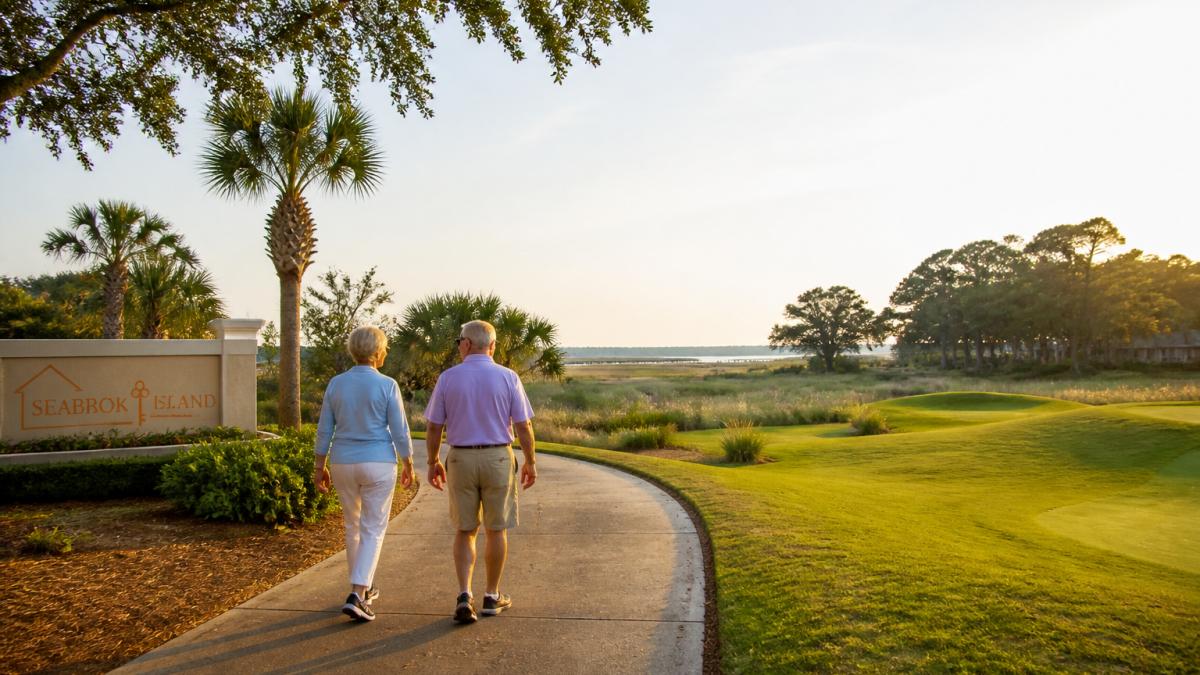
Seabrook Island is a gated coastal community named in local golf-community listings as an option for resort-style living. For buyers who prioritize privacy and a gate, it’s the strongest candidate here.
(/best-55-plus-communities-charleston-sc/) comes down to four questions: Is it age-restricted? How does golf access actually work?
Age-restricted vs. continuing care vs. golf neighborhood. These are three different legal and financial products, and the paperwork differs completely.
- Age-restricted (55+ or 62+). Residency is limited by a recorded deed restriction or covenant. The restriction runs with the land, so it binds future buyers too. Ask to see the recorded instrument, not a marketing brochure. Under the federal Fair Housing Act’s housing-for-older-persons exemption, a community must meet specific requirements to legally operate as 55+ or 62+, including that at least 80% of units be occupied by at least one person of the qualifying age. If a community cannot show you the recorded restriction, treat the “55+” label as marketing.
- Continuing care retirement community (CCRC). Also called a life plan community. You sign a contract that bundles independent living with access to assisted living, memory care, or skilled nursing as needs change. These contracts typically involve a large entrance fee plus monthly fees, and they come in different types (Type A, B, and C) that determine how much your monthly fee rises if you need more care. This is the model where “can I stay here as I age?” has a real answer.
- Golf neighborhood. A subdivision built around a course. No age restriction, no care continuum. You own a home, you pay HOA dues, and golf access is a separate question entirely.
Golf access: the four things to pin down.
- Who owns the course? A course owned by the community or its HOA is a different risk than one owned by a third party or a management company. If the owner can sell or close the course, your golf access is not guaranteed.
- Is membership required, optional, or unavailable to residents? “Golf community” can mean included membership, an optional club you may join, or a public course next door that gives you nothing.
- What are the dues, and what do they cover? Ask for the current schedule in writing, plus the date of the last increase. Initiation fees, cart fees, and minimum spending requirements are often separate from headline dues.
- Do residents get priority tee times? In resort communities, outside play can crowd out residents during peak season. Ask how tee times are allocated.
Total costs: add these four numbers before you compare.
- Purchase price or entrance fee
- HOA dues (monthly or annual)
- Club dues and any initiation fee
- Any separate course or amenity fee
The cheapest home is often not the cheapest ownership.
Aging in place: what to actually look at.
- Single-story layouts. Stairs become the first problem. Ask whether the primary living space, bedroom, and full bath are on one level.
- Door widths and bathroom accessibility. Standard doorways can be too narrow for a walker or wheelchair. Ask about doorway widths and whether bathrooms have step-in showers or can be modified.
- Maintenance structure. Who handles the roof, the yard, and the exterior? A community that handles these lets you stay longer.
- Healthcare proximity. Ask how far the nearest hospital and specialist care are, and whether the community provides transportation.
- Care options on site or nearby. If staying in one place as your needs change matters, prioritize communities with care options on site, and read the contract carefully with a lawyer. For continuing care options in the region, South Carolina’s Department of Consumer Affairs guide to continuing care retirement communities explains how these contracts are regulated.
Questions to ask when choosing a 55+ community:
- Is the community legally age-restricted, and can you show me the recorded deed restriction?
- Is golf membership required, optional, or unavailable to residents?
- What are the current HOA and club dues, and when did they last increase?
- Who owns the golf course, and could it be sold or closed?
- Are there single-story floor plans, and are doorways and bathrooms accessible?
- How far is the nearest hospital and specialist care?
- What happens if you need assisted living later?
That last question is where continuing care retirement communities Charleston buyers ask about most.
One more note on the region: coastal South Carolina’s climate supports year-round golf, but summer heat and humidity shape when people actually play.
Frequently Asked Questions
Which Charleston retirement communities have golf courses?
Five options frequently come up: Daniel Island, Wild Dunes Resort, Seabrook Island, Kiawah Island, and Shadowmoss Plantation. Golf access differs at each. Some have an on-site course with a club membership, while others sit next to a course where residents buy golf separately. Before you tour, ask whether the course is owned by the community or a separate operator, and whether residents get any priority tee times.
Are golf-course communities near Charleston age-restricted?
Not always. Age-restricted 55+ communities enforce a minimum age under the Housing for Older Persons Act, while general golf neighborhoods near Charleston have no age rules at all. Wild Dunes Resort, Seabrook Island, and Kiawah Island are resort and residential communities rather than age-restricted villages. Daniel Island is described as an active-adult community. Confirm the recorded age restrictions before you make an offer.
What is the difference between a 55+ community and a continuing care retirement community?
A 55+ community is built around age-restricted housing and lifestyle amenities, and it does not include care services. A continuing care retirement community, often called a life plan community, bundles independent living, assisted living, and skilled nursing on one campus, usually through a long-term contract and entry fee. If you want to age in place with care available later, a continuing care community fits better than a golf village.
What should I ask when choosing a 55+ community with a golf course?
Ask who owns the course, whether membership is required, what the dues cover, and whether residents get tee-time priority. Also ask about the age restriction in writing, HOA rules on rentals and guests, and how close the nearest hospital is. Schedule a visit during the season you plan to live there, since summer heat and winter crowds change how often you will actually play.
Is Charleston a good place to retire with year-round golf?
The climate supports golf most of the year, with mild winters and warm summers, so many retirees play in every season. Summer heat and humidity push tee times to early morning, and coastal storms can close courses for short periods. Outside golf, the area offers healthcare access, cultural attractions, and a range of housing types, which is why active adults keep Charleston on their shortlist.